


From Los Angeles to Washington, D.C., municipal rat programs are testing everything from fertility control to smart traps. The method rodentologists keep returning to is also the least glamorous, requiring them to cut off the food.
At a two-day "rat academy" run by D.C. Health this summer, urban rodentologist Bobby Corrigan gave a room of city employees, neighborhood commissioners, and property owners a blunt formula for shrinking a rat population. No food, no rats. His argument is that cities spend decades poisoning burrows while leaving the food supply untouched on the curb, where bagged trash, open dumpsters, and greasy bins sit out in plain sight.
The numbers behind that argument are hard to ignore. Rat sightings in Washington have climbed more than 800% since 2012, growing faster than in far larger cities like New York, according to reporting by The 51st. The District's rodent control program identified and treated more than 25,000 burrows in 2025 alone, per the city's new public rat dashboard. And Washington is far from the worst off.
The rattiest cities in America
Each year the pest-control company Orkin ranks U.S. metro areas by the number of new rodent treatments it performs. Its 2025 Top 50 Rattiest Cities list, released in October of that year, ended Chicago's decade-long run at No. 1. Los Angeles took the top spot, with warm weather, dense neighborhoods, and a busy restaurant scene cited as the draw. Washington, D.C. sits at No. 6. The top 10 are listed below.
|
Rank |
City |
YoY move |
|---|---|---|
|
1 |
Los Angeles, CA |
▲ 1 |
|
2 |
Chicago, IL |
▼ 1 |
|
3 |
New York, NY |
— |
|
4 |
San Francisco, CA |
— |
|
5 |
Hartford, CT |
▲ 8 |
|
6 |
Washington, D.C. |
▼ 1 |
|
7 |
Detroit, MI |
▲ 1 |
|
8 |
Philadelphia, PA |
▼ 1 |
|
9 |
Minneapolis, MN |
▲ 2 |
|
10 |
Denver, CO |
▼ 4 |
Source: Orkin 2025 Top 50 Rattiest Cities List. Rankings reflect new rodent service calls between August 2024 and August 2025.
A ranking like this maps the same underlying condition of population density, food waste, and aging infrastructure. This is why the cities on it are converging on a similar toolkit. Here is how municipalities are going after the problem.
1. Containerize the trash
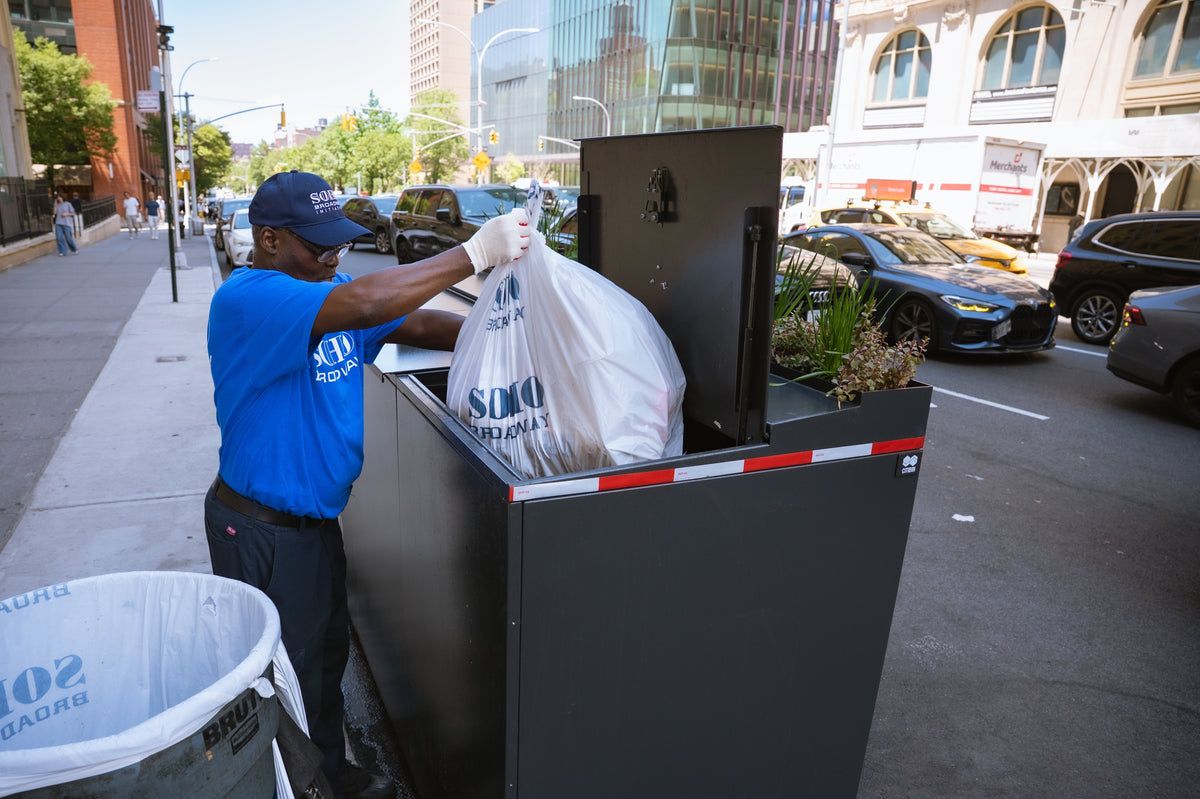
Every credible rat program starts here, because food access drives population size. When a city takes bagged garbage off the sidewalk and seals it inside rat-resistant containers, it removes the reward that keeps rats breeding and returning to the same block.
New York offers the clearest proof. As the city moved toward mandatory containerization and composting, officials reported that rat sightings fell consistently for the better part of a year, after decades of leaving millions of pounds of trash bagged on the curb every night. Washington is now trying to follow that lead. Council member Christina Henderson has introduced legislation to fund rodent-resistant public trash cans in the city's busiest commercial corridors and business improvement districts, replacing the open-top and chewed-through bins that line many alleys. Boston has taken a parallel step in public space, selecting CITIBIN as its vendor and implementing CITIBIN’s sealed trash enclosures for its Project OSCAR community composting program so residents can drop off food scraps without feeding the rats.
2. Rodenticides and bait
Poison remains the most widely used method. Cities treat burrows with anticoagulant bait that causes internal bleeding, often paired with tracking powder that rats carry back into the nest. It works on contact, though it carries two well-documented limits in that it does not solve the access problem, because a rat with a full dumpster nearby usually ignores the bait box, and the toxins move up the food chain. One wildlife clinic found that 85% of the injured hawks, eagles, and other animals it examined over nine months had been exposed to rat poison. One legislative proposal, the REMY Results Amendment Act, would restrict the private sale of rat poison and require certification to use it, shifting rodenticide back toward trained, city-directed application.
3. Fertility control
The newest tool is contraception. Cities deploy edible or liquid fertility-control bait designed to suppress reproduction rather than kill outright, a slower approach that avoids the wildlife toxicity of poison.
What Cities Are Actually Doing About Rats
Washington built a three-week rodent blitz across Adams Morgan, Eastern Market, and Chinatown, combining poisoned bait, tracking powder, and liquid birth control. No published study has proven fertility control works at scale in a real urban setting. Lab results are promising, but experts who support it agree on one point, which is that it does nothing unless the trash is contained first. In Kingman Park, residents have launched a year-long community study pairing contraceptive feeding stations with trash-management practices to find out which combination produces measurable results.
4. Traps, burrow treatments, and new tech
Beyond bait, cities pump carbon monoxide and dry ice directly into burrows to collapse nests, and a growing class of electronic and smart devices logs each catch so crews can map activity neighborhood by neighborhood. These methods are precise and pet-safe relative to broadcast poison, but they are labor-intensive and, like everything else on this list, temporary if the food source remains.
5. Data, dashboards, and enforcement
Modern rat programs increasingly run on real-time metrics. Washington launched a public rat dashboard in 2026 that tracks burrows identified, those treated, and 311 complaints. A separate bill would strengthen enforcement of trash violations against the businesses and properties generating the exposure. Corrigan's recommendation to cities is a coordinated approach combining sanitation, health, and code enforcement working the same map together, rather than each agency treating rats as someone else's problem.
6. Public education
Because most rat activity traces back to human behavior, including overfilled cans, unwashed bins, and trash left beside the container rather than inside it, outreach has become its own strategy. Some cities run rat academies that train property owners and commissioners, while community rat walks take residents through alleys after dusk to see a block the way a rat does. The goal is to make good trash habits visible and routine, so containerization holds over time.
Shared dependency across every approach
Poison, contraception, traps, dashboards, and education all have a place in a serious municipal program. But they share a single dependency in that none of them works for long while food sits exposed in public space. Every serious rodent-control program, in Washington and elsewhere, returns to the same foundation. Containment.
CITIBIN's modular, sealed trash enclosures address that foundation directly. They containerize waste at the source, securing trash, recycling, and compost between pickups on city streets, in business districts, and across campuses and public spaces. Built from marine-grade aluminum and designed for high-visibility streetscapes, they give cities a durable, rodent-resistant base that the other tools in a municipal program depend on to hold.
What's Next for Municipal Containerization
Cities across the country are moving from open bags to contained waste, and this shift is expanding what rodent control programs can achieve. Removing the food source between pickups makes other interventions, including poison bait and fertility control, easier to sustain over time. When trash is secured, the rest of a city's rodent program operates from a more reliable starting point.
CITIBIN works with commercial and municipal partners to support that transition, with trash enclosures built for high-traffic public spaces, BIDs, and business corridors where unsecured waste drives the highest rodent pressure. If your district or city is considering containerization, CITIBIN's municipal team is available to walk your site, assess your waste volumes, and provide a rendering of what your trash would look like before and after containerization. Our proposals are thorough and designed to make it easy for you to explore options.


