


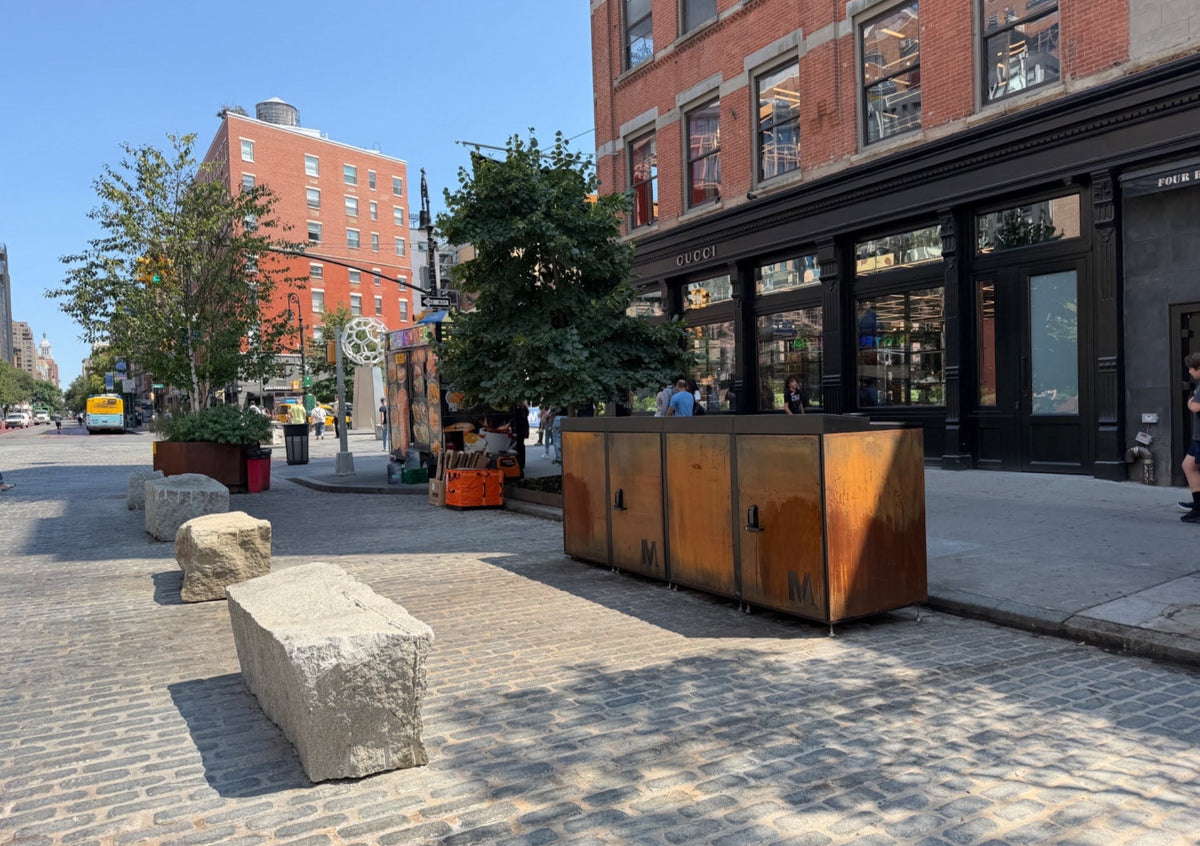
Most people who need a trash enclosure already know it. They've seen a unit at a neighbor's building, or watched the same messy situation at their own property drag on for years. What holds them back is not knowing what the ordering process actually looks like, or whether getting a price means a long exchange.
Getting a quote from CITIBIN starts with two questions, where the enclosure is going and how many cans it needs to hold. From there, the process is fast. A rendering of how the finished enclosure will look in the actual space is included before any commitment is made.
If you're in the NYC metro area, a free on-site estimate visit is also an option. Someone from the team comes to the space, takes a look at the dimensions and conditions, and makes sure the recommendation fits. That visit is free, and it often surfaces details a photo doesn't capture, including the exact footprint, how the doors need to swing, and whether a U-configuration makes more sense than a linear one. Outside the metro area, a photo of the space and the address get the same process started remotely.
The quote is specific to your space because the right enclosure depends on the number of cans, the layout, and which configuration actually fits. Rather than a price range pulled from a chart, you're getting a proposal built from the dimensions, conditions, and can count of the actual space.

What a Quote Requires
The address gives the team everything they need to size and configure the enclosure correctly. A photo does the rest. Trash spaces vary more than people expect. Some run along a narrow building wall. Some open onto a wider sidewalk with room for several modules. Some are needed in a tight corner and can gain space efficiency with an L- or U-shape. A photo of the space means the proposal reflects real conditions rather than a guess.
Size is determined by the cans an enclosure needs to hold. The Small accommodates 32–44 gallon cans, the Medium handles 45–55 in that range, and the Large covers 65–96. Knowing which cans you have, and how many, is the fastest way to land on the right enclosure from the start.
Can count determines module count, and that total sets the overall footprint. A property with two 44-gallon bins needs a different configuration than one managing six 96-gallon containers. The size tier follows from the cans themselves. If you're not sure which tier your cans fall into, sharing a photo of the space usually makes that clear quickly.
The space itself matters just as much. A tight side yard with one open face prices differently than a corner lot that could support a configuration spanning two walls. Door swing, access points, and whether the enclosure needs to be freestanding or anchored against a structure all factor in. Some of those details only emerge during an on-site visit; others show up in a good photo. Either way, the goal before any number is quoted is a clear picture of what the space actually requires, not a guess based on the address alone.
Because roughly 80% of the product's cost is in the metal, the material choice has a real effect on price. Powder-coated aluminum costs more upfront than steel or wood alternatives. The frame is rust-resistant and built to hold its shape over years of outdoor use with minimal maintenance compared to wood and steel alternatives. Think of it as long-term outdoor furniture, not an expensive trash bin.
What the Rendering Reflects
Trash enclosures are not small objects. They occupy real estate at the front of a home, a building entrance, or a commercial property, and adding one changes how that space looks permanently. A photorealistic rendering of your actual address lets you see exactly what will be installed before committing, based on real conditions rather than a generic layout.

How the Estimate and Rendering Come Together
The visual preview is built from the same information that produces the quote, covering your address, a photo of the space, and your can count. For NYC metro customers who schedule an on-site estimate visit, the team walks the space beforehand, which means the rendering reflects details a photo alone might not capture, including how the unit interacts with a gate, a stairway, or a neighboring facade. Because those measurements come from the actual site rather than a generic approximation, the rendering gives you an accurate preview of what the final installation will look like.
For properties outside the NYC metro area, the process works from what you send. If the photo doesn't give the team enough to work with, they'll ask for another angle before producing the rendering rather than guessing.

If the rendering prompts a question, a configuration change, or a different size altogether, that conversation happens before anything is ordered. You've seen what the finished result will look like before you confirm it.
A photo captures general dimensions and layout, but it may not show the height of a neighboring fence, the swing radius of a gate, or how close a stairway runs to the wall. An in-person visit or a photo catches those details, and the rendering draws on direct observation, so the dimensions and clearances shown reflect what is actually on-site.

To schedule an on-site visit, reach out through the contact page and note your location. The team will confirm availability and set a time. For outside-area requests, once the submission is in, the team reviews everything together. For spaces where the photo gives clear sight lines and measurements, a rendering typically comes back within a day or two, showing your actual space with the enclosure sized and positioned based on what was submitted.
From Rendering to Ready
If something in the photo raises a question, you'll hear back before the final image is produced rather than after. That might mean a second angle of the space, a clarification on can size, or a note about something visible in the photo that affects fit. It's a short back-and-forth, not a lengthy intake process.
The rendering is where the quote becomes concrete. You can see the enclosure in the space before committing to anything, and if the configuration needs to shift, that happens at this stage. Adjusting a module count, switching a color, or changing the layout is easier to do in a rendering than after production begins.
Once the rendering looks right and the quote is approved and invoice paid, it’s time to schedule delivery and installation. CITIBIN enclosures are prefabricated, modular, and ready to assemble. Residential units ship directly to you, and can be installed DIY using intuitive assembly instructions, or through our nationwide network of installers. For larger or more complex installations, the team coordinates logistics based on the site.
By the time an order is placed, the dimensions, configuration, and delivery destination are already confirmed.
Share your address and a photo of the space. A rendering comes back showing how the enclosure fits, sized and configured for the cans you already have. If anything needs clarification, questions are resolved prior to production moving forward. If you're in the NYC metro area and want someone to walk the space with you first, that visit is included.
Getting a Quote for a District, Park, or Campus
A map rarely shows where bags pile up or how full the litter baskets get, so a municipal quote starts with a walk, not an address and a photo.
The process begins with a walk-through of the district, park, or university. It is as much a relationship-building step as a survey. The team learns what the trash problems are, how the space is used, and where the problem areas sit.

Municipal trash problems come down to two. Bags piling up are addressed through containerization, using trash enclosures. The second, litter collection, is addressed with BasketPlus, CITIBIN’s public trash receptacle line.
After the walk-through, CITIBIN creates a rendering of the most problematic area. The rendering is included in the proposal, which comes with visuals for the people who approve the project, such as boards and city councils.

Sizing also works differently than it does for a home. Instead of counting cans, the quote is built on a volume assessment, because the amount of trash a location generates each day determines how many modules it needs.

Because the system is modular, modules can be added or removed as needs change, and CITIBIN keeps inventory in its warehouse to make that possible.
Contact us for a quote!


